


|
|
|
|
|
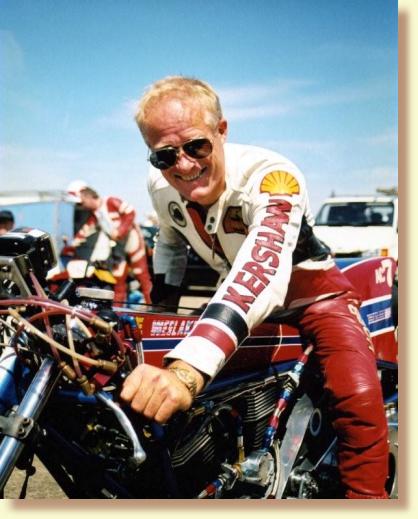
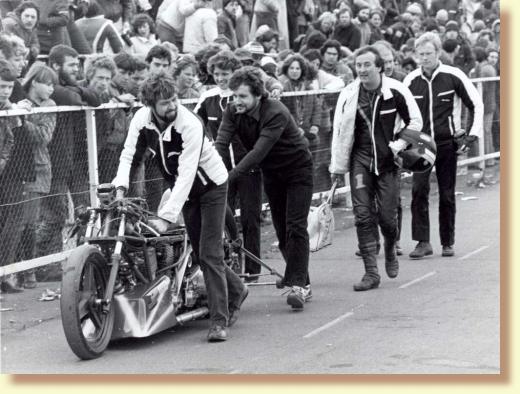
The reasons for John�s decision to give up racing were various. His work as a Chartered Engineer with Eastern Gas was beginning to intrude into his leisure time as he grew in seniority. He also had a young family and the long hours involved with the bike deprived him of time with his wife and children. Although John had been far more fortunate than some in securing sponsorship, cash was an issue. But perhaps the most decisive factor was that John could clearly see that The Hobbit, and all the other vertical twin-based machines, were old technology. It was obvious to him that the future lay with the Japanese multi-cylinder engines and that if he was to stay at the cutting edge of performance he would have to invest in a completely new machine. So for all of these reasons the decision was made to hang up his leathers. However, this did not necessarily mean the end of The Hobbit. John realised that he had been at quite a disadvantage to the likes of Henk Vink because, unlike Henk, John was not supported by a large team. Unfortunately Chris Stevens had to withdraw and this led to Ray Baskerville also leaving the fledgling organisation almost before it had come into existence. This is where John�s previous association and friendship with Jonny Munn came to the fore because Jonny gratefully accepted John�s offer to ride The Hobbit. Chris Tee stepped up as Chief Mechanic and Pete Holtom, who had previously crewed for Jonny, came on board. This was now a formidable force because Pete was an RAF aviation electronics specialist who worked on Nimrod early warning aircraft, and he went on to work for the McLaren racing team. Chris Tee was also highly talented as he went on to work in Formula 1 with the Williams and Arrows teams and to run his own engineering company offering services to the F1 world.
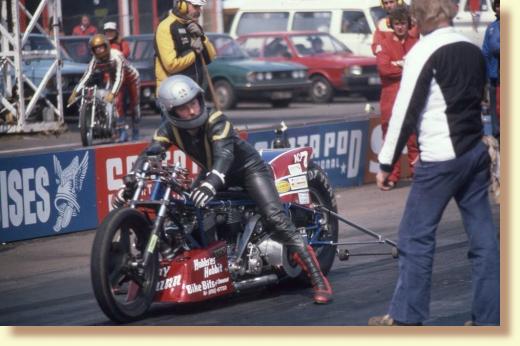
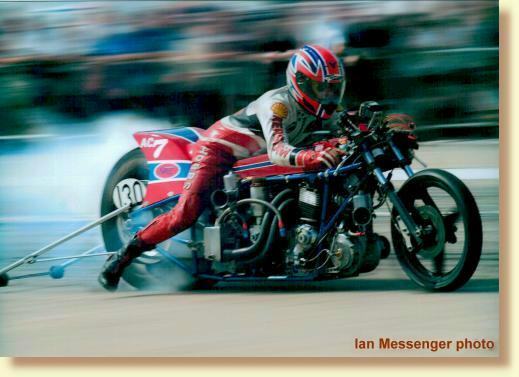
1980 No technical changes to the bike were made for the 1980 season although it did receive a new lick of paint. Jonny Munn�s first competitive outing on The Hobbit was the Easter meeting at the Pod held from 4 to 7 April, it turned out to be a fairly traumatic experience for him. His first run was a very creditable 10.55/140 effort and he finished up as second qualifier behind Henk Vink with a superb 8.71 second run at 160 mph. So far so good, in fact very good considering he was acclimatising himself to the quickest and fastest fuel bike in Europe. Jonny met Pete Smith in the first round of competition and he won this with a hole shot 9.19/139 to Pete�s 9.05/155. The downside was that Jonny got into an absolutely horrific tank slapper at the top end which he somehow managed to control. Back in the pits Jonny was very badly shaken by his experience which is hardly surprising when you all but lose it whilst covering the ground at over 200 feet a second. It is a testament to Jonny�s courage that he managed to put that experience behind him and came back out in the final to ran a stout 8.89/152 to lose to Henk Vink�s even stouter 8.57/171. Later analysis showed that part of Jonny�s problem had been caused by the fact that he was overstretching when seated on The Hobbit, some adjustments were made to make him more comfortable and this problem never manifested itself again. The May Day meeting at Santa Pod was almost a repeat performance of Easter although fortunately without the trauma. Jonny qualified The Hobbit second with a strong 8.65/162 behind, you guessed it, Henk Vink. Jonny took out Jeff Byne in the first round with a great 8.36/163 to Jeff�s losing 8.68/157. Henk soloed to an 8.64/166 after Mick Butler experienced gearbox problems and could not run. In the final Jonny well and truly put any lingering gremlins to bed when he beat Henk in a very close race 8.43/169 to 8.49/169.
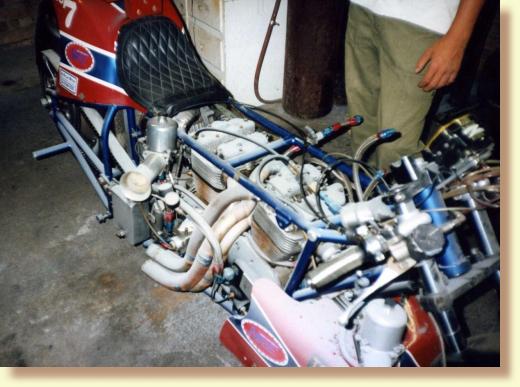
The Whitsun meeting was a disappointment because a damaged coupling gear meant The Hobbit could not make it out for round one. Jonny�s best qualifying time was very encouraging though because he ran a good 8.43 seconds at 164 mph. The next meeting was the Summer International World Series held at Santa Pod on 5 and 6 July. The August Bank Holiday Super Nationals saw Jonny and Henk run side-by-side bye runs in an effort to coax a seven second run. Henk got to the stripe first with an 8.24/173 with Jonny not far behind with an 8.37/166 clocking. It was the same result in the final with Henk taking it with a super consistent 8.21/169 while Jonny improved to a fine 8.29/170, his best run to date. The BDR & HRA September International World Finals provided the Hobbs team with another Superbike win. Jonny fought his way through to the final by putting out Ian Messenger on the Pegasus double Norton in the first round and shutting down Mick Butler on his 1000cc V-twin Weslake in the semis to meet Dutchman Cees Van Dongen on his CBX Honda six in the final. Cees had earlier taken out Henk Vink in the first round. Jonny took the win running 8.46 seconds at 168 mph to Cees Van Dongen�s 8.66 seconds 158 mph pass. Jonny went on to win the National finals meeting at Santa Pod on 11 and 12 October but his engine expired in the final and was lucky to beat Nigel Patrick whose clutch gave up the ghost. Jonny overpowered the track at the Fireworks meeting on 8 and 9 November and lost in the semi-final against Nigel Patrick who took the win with a very modest 9.40/130. Chris Tee was awarded the Mechanic of the Year trophy by the NDRC at their dinner and dance in recognition of his efforts rounding off a very successful first year for John Hobbs Racing. 1981 In view of the handling problems experienced in 1980, it was decided to go back to the drawing board and design a completely new chassis for 1981. This not only gave the opportunity to tailor-make it to fit Jonny, but also enabled several innovations to be included allowing for much easier access and maintenance to the engines and drive train. During the winter of 1980/81 John and Chris burnt the midnight oil to completely re-engineer the bike. A lower and more purposeful looking Hobbit, sporting a much wider 11� inch Goodyear slick fitted to a Cragar rear wheel, appeared in 1981. The first meeting of the year for the team was at Easter, the meeting being held at Santa Pod from 17 to 20 April. Jonny was runner up with an 8.74/158 to Mick Butler�s better 8.57/160.
Team Hobbit�s fortunes improved for the May Day meeting but that was more than could be said for the weather which forced the use of emergency qualifying times for the eliminations. Jonny took out Pete Woods in the first round 8.71/146 to 9.36/147. Jonny then took his revenge over Mick Butler in the semis by defeating him with an 8.74/151 clocking to Mick�s off par 9.16/152. The final saw Jonny triumph over Jeff Byne to take the win with another very consistent run, 8.79/146 to Jeff�s 9.00/153. The Whitsun meeting held from 23 to 25 May at the Pod was also affected by the weather with only the first round of competition being run, the remaining rounds were held over until the meeting on 3 and 4 July. At the July meeting Jonny won his held over semi-final race against Nigel Patrick with an 8.85/149 (Nigel broke). Mick Butler and Jonny were matched against each other in the final and this time it was Mick�s turn to take the victory in an extremely close race with an 8.85 second run at 153 mph. Jonny narrowly lost out with an 8.78/153 pass. In the second Pro Fuel final of the weekend Jonny made no mistakes and took out Jeff Byne for the win with an 8.76/158 run to Jeff�s 8.84/154 clocking. The 1981 August Bank Holiday meeting at Santa Pod was historic in that all eight bikes in the field had qualified with times under nine seconds. John was back in the seat for this meeting and he blew Rod Pallant away in the first round with a strong 8.34 second lap at 167 mph. John faced up against Brian Chapman in the semi-final but lost when his magneto split during the run. 1982 1982 took on a more international flavour with the team racing at several events in Holland, as well as both Circuit Paul Ricard and Le Mans in France. Their first outing of the year was at the Easter Santa Pod meeting when Jonny, just back from a trip to Australia, was bang on form as top qualifier and winner of the Pro Fuel final. In the semis he shut down Jeff Byne�s 1640cc Triumph double Hurricane and beat Pip Higham in the final with an 8.32 second 162.6 mph run to Higham�s troubled 11.57 second 85.98 mph effort. John made his annual outing on The Hobbit over the weekend of 2 and 3 June at the Pod. The race report reads �a banzai run of 8.5s right off the trailer after not having ridden the 1700cc double Weslake for a year showed why he was Europe�s best for such a long time. The series of 8.3 sec runs that followed, with terminal speeds approaching 170mph made it seem as if he had not been away from regular competition for over two years.� The final round of the European Pro Fuel Challenge Cup fizzled out to an inconclusive end at the September International meeting when a thunderstorm delayed racing and an off-course car demolished the timing lights delaying the meeting still further. Promoter Roy Phelps would not run late races, claiming that noise would lead to local protests. Only the first round of Pro Fuel Bike was completed, leaving the competitors including a large international contingent from Holland, Sweden and France fuming. What might have been can only be imagined, the qualifying had been electric with bump spot for the eight slot Pro Fuel Bike eliminator at a record low of 8.62sec and Jonny qualifying number two with an 8.22 second run at 168mph.
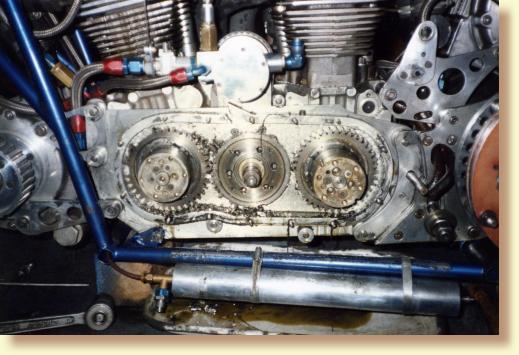
Jonny Munn had been born in Australia and held dual nationality. He decided to return down-under and still runs a very successful motor cycle business there to this day. John decided that he would not continue with racing in the face of this set-back and therefore 1982 was the last year in competition for the team. However, John was determined that John Hobbs Racing should go out in style so he took up the hot seat once again to record a fantastic 8.21 second time at the November Fireworks meeting on what must have been an indifferent surface to close out his drag racing career in fine style. The team won the Motorcycle Scrutineers� Trophy and this was awarded at the BDR & HRA dinner and dance, the team were also runners up in the Superbike points championship. And so at the end of 1982 the most successful British-engined drag bike in Europe and possibly the world was ignominiously stored beneath a bench in John�s workshop. John made a brief re-appearance on the bike in 1984 at a BDRA. meeting held at Blackbushe, but in 1985 Jonny made a return trip to the UK and persuaded John to get The Hobbit out for him to ride at the June NDRC International Bike Race Meeting held at Long Marston. Jonny realised this would probably be his last chance to ride the bike and pulled out all the stops. On his third attempt he qualified for Top Fuel Bike with a storming 8.19 second 153 mph pass. Unfortunately the following day in the first round of competition the engine coupling gears let go (see picture below) putting the bike on the trailer. However, Jonny returned to Australia a happy man having posted his quickest ever ET on The Hobbit, just short of John�s 8.07sec run back in 1979. Click here to see Jonny's timing ticket for that run.
John takes up the story. �It was early in 1990; I�d been watching drag racing on the telly and suddenly got the urge to race again. I discussed it with Cheryl and she was all for it. The Hobbit was dragged from under the workshop bench to reveal a somewhat forlorn and dust covered bike in need of care and attention. On inspection everything seemed in good working order, so after a good deal of elbow grease and energetic polishing the Hobbit was treated to a new set of plugs and we set off bright and early one Saturday morning for The BDRA Nationals, to be held at Avon Park, Long Marston over the weekend of 15 & 16 September 1990. Nigel Tee (Chris Tee�s older brother) came along to lend a hand as crew and we arrived at the race meeting not sure what the weekend would bring. The bike was unloaded and everything made ready for a qualifying run. I was overwhelmed by the number of people, car and bike racers alike as well as members of the public, who came up to me and said how great it was to see me out again racing the Hobbit. The first run was an early shut-off half pass which netted a 9.897 second 93.407 mph. With good track conditions the bike was launching well with the front wheel in the air for the first 100 yards or so. Everything was set for a full qualifying pass and I was confident with myself and the bike. The next run felt like the quickest I had ever done, not having ridden for so long, and netted a great 8.514 seconds at 162.953 mph which qualified me for the number one spot in Top Competition Bike. On the Sunday I went on to win the eliminations with times of 8.529 seconds at 162.402mph, 8.416 seconds at 162.611 mph, and then I beat Gordon Diggins in the final with a time of 8.352 seconds at 159.19 mph to his loosing 10.209/145.235. We went home with a warm glow of satisfaction, knowing that the return of The Hobbit had been a resounding success, which was much appreciated by the crowd and very much enjoyed by ourselves.
A Return to Sprinting �Early in 1993, I was contacted by Terry Homan of Ultimate Classic Bike Promotions Ltd., who asked me if I would take The Hobbit along to The Ultimate Classic Bike Event and George Brown Memorial Sprint later in the year. I said I would be happy to do demonstration runs. The bike had not received any serious maintenance since I stopped racing in 1982 so it was decided to do a complete strip-down and re-build checking everything down to the last nut and bolt. The frame was checked for cracks and a number of major components were replaced including the crankshaft of the front engine and both crankcases. The re-build was completed towards the end of June and a trip to Avon Park was arranged over the weekend of 26 and 27 June. I made a number of easy runs with no times or speeds recorded to check that everything was OK. �So, on Sunday 25 July 1993 I appeared with The Hobbit at North Weald airfield, alongside Alf Hagon who was making his one and only comeback on his legendary V-twin JAP. I made a number of runs on the very slick and bumpy North Weald track, all in the mid 10 second bracket. These runs were well received by the large crowd of biking enthusiasts who had come to watch. However, the overriding memory of the meeting for me was Alf Hagon on board his single speed Hagon JAP smoking the rear tyre for most of the quarter, pure nostalgia. The other thing that was particularly pleasing was the number of people, often complete strangers, who came up to me expressing their thanks and appreciation for giving them the opportunity to experience the site and sound of The Hobbit running on the strip again. Many of these people would only have been children when they first saw the bike, probably at the Pod taken there by their parents. All of this convinced me that the place for The Hobbit was back on the strip, not lurking under my workshop bench or even stuck in a stuffy old museum somewhere. So I decided to make the annual pilgrimage to North Weald each year, to keep The Hobbit running and in the public view.
�Those Classic Bike Events at North Weald provided me with a lot of enjoyment, not least because I never knew who would pop out of the woodwork. Over the years I made contact with many old racing friends and acquaintances, resulting in several Racer Reunions, the latest being Ray Baskervilles 60th in August 2007 when we all met up to chat about old times over a beer or two. �The last time the Hobbit appeared at North Weald was at the final Classic Bike Sprint organised by Terry Homan and Partners in July 2003. I was determined to make it a day to remember and spent several weeks preparing the bike to make sure it was on top form. Earlier in the day I had put down several low nine second runs on the bumpy track, when it was decided to finish off the meeting with a match race between myself and Terry Fischer on his double 500cc engined Triumph. Mick Butler was commandeered to be starter in true Stu Bradbury fashion with a couple of umbrellas as starting flags. As Mick raised the brolly I left the start line hard and beat Terry to the finish with an 8.80 second 154.70 mph run, which was good enough for the course record. Later in the year I went on to take the course record at RAF Wattisham with a string of eight second runs culminating in an 8.68 second at 163.40 mph. On 24 July 2004 I appeared with The Hobbit at London City Airport alongside Steve Woollett who was doing demonstration runs on his fuel bike. Steve�s somewhat hairy run on the tricky surface inspired me to an 8.99 second 162.40 mph pass to again take the course record for the classic bike class.
�At the time of writing (spring 2008) The Hobbit�s last appearance was made at an NSA-organised sprint at Santa Pod on 26 September 2004. This was not a huge success. The phenomenal traction that Santa Pod provides these days caught me unawares. I did not back the clutch off as I should have and the result was the crank of the rear motor was literally ripped out at the eighth mile resulting in a 9.69 second 94 mph pass which was still good enough to win the Unlimited Capacity Racing Class and post second quickest time of the day! The good news is that my long time friend Derek Chinn is manufacturing the necessary bits and pieces to have The Hobbit out again in 2008.� "In the meantime I have been keeping my hand in with the occasional outing on Dave Clee�s 920cc Supercharged Puma Triumph, which is great fun to ride but no substitute for The Hobbit." Readers will be pleased to know that Derek Chinn did the necessary and John was back out riding The Hobbit in 2008 as the following video clip taken at North Weald in August of that year proves.
British Drag Racing Hall of Fame
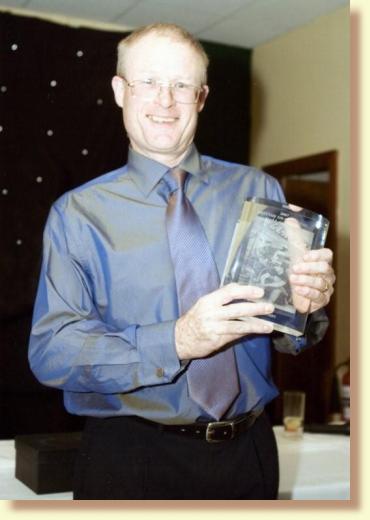
On 3 February 2007 John Hobbs became the first motorcycle racer to be inducted into The British Drag Racing Hall of Fame, in recognition of his contribution to the sport. The citation reads �Among his performance achievements are notably bettering esteemed visitors from America in ET and speed.� Dedication To my wife Cheryl and children Mark and Emma, their influential role, help, support and encouragement over the past 42 years made it possible. John Hobbs Epilogue I hope you have enjoyed reading the story of John Hobbs' racing career which, after 42 years, has not finished yet. It has been a story of constant development between 1966 and 1982 as he battled to extract the best performance from the technology and the resources available to him. You may be wondering why each page is headed 'Innovator and Applicator''. It came out in conversation with John and it dates back many years to comments made to John by the late Danny Johnson. He said that it was all very well coming up with innovative ideas, but in order to succeed the trick was to be able to apply them effectively. It struck me that John and Danny have an awful lot in common.
�It�s all about nostalgia and preserving the history of the sport�
I am indebted to Chris Dossett and his excellent Trakbytes website
Since this article was first published John has had the Hobbit out in 2008 on two occasions. - 1000 Bike Festival at Mallory Park
� Alan Currans & John Hobbs
|
|
All material on this site is copyright |
|
|
.jpg)
.jpg)