


|
|
|
|
|
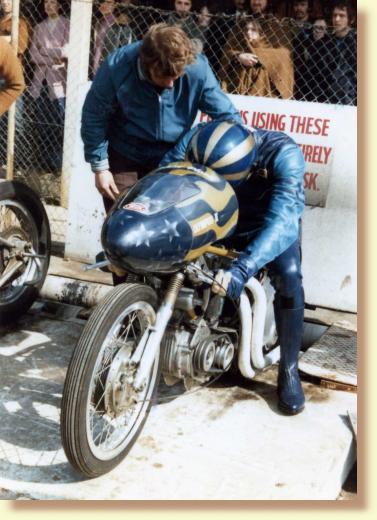
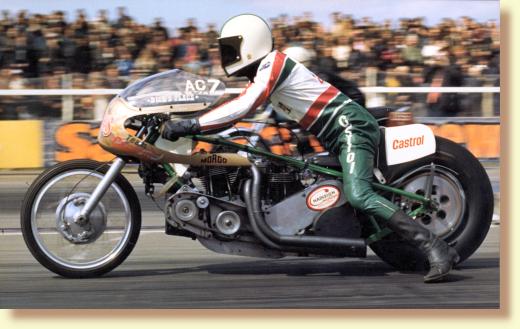
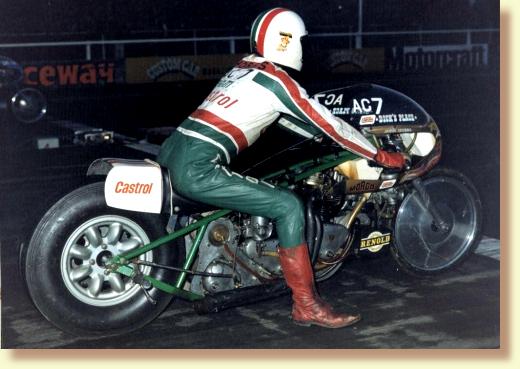
The double was christened Olympus II but it underwent rapid development in successive years and so the story has to be split into three sections. Mark I
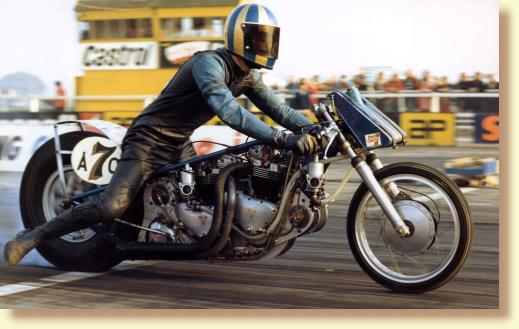
The theory was that if you had two engines, each with its own supercharger, you would double the power output at a stroke. A twin-engined bike still only has two wheels, one set of forks, handlebars, brakes, one clutch and one gearbox. Furthermore, a frame for a double does not weigh twice as much as a frame for a single. The result therefore should be twice the power and a better power to weight ratio - a �win-win� situation if ever there was one. Another advantage was that you had the opportunity to de-tune the engines to improve reliability and still have a massive power to weight advantage over a single-engined machine. I make that a �win-win-win� situation. This is all fine and well on paper but it is only when you have a go at something like this that the gremlins start to appear, and boy did they appear. Many of you may have heard of Moore�s Law which says that year-on-year computers become more unfathomable and difficult to use (or is it something to do with the power of the processors?). Anyway, John�s experiences with the double engine set up caused him to rapidly come up with Hobbs� Law which states that the aggravation involved with running a drag bike increases by the square of the number of engines. So in his experience Olympus II was not twice the trouble of its predecessor - it was four times as bad. The problems began to surface around some of those components which a few paragraphs back were being seen as a benefit to the power to weight ratio. The trusty 4 inch Avon slick which had served sprinters and drag racers for years was suddenly found wanting when you attempted to squirt twice as much power through it. It was impossible to get off the line without the slick breaking loose under the horsepower. This was probably a good thing in its way because if the slick had really hooked up it would undoubtedly have over-stressed the clutch and/or the gearbox neither of which were really designed to take the punishment unleashed by a couple of blown Triumph lumps. Another area of weakness in the driveline was the chain linking the two engines together. This was just a bit of common or garden final drive chain but it was being asked to take the full force of the front engine with no clutch to soften the blow, and it was spinning at engine speed which was much faster than it would normally run. The heat generated by this, and the enormous centrifugal force acting on it, meant that it developed a habit of regularly letting go at the top end. So the easy bit of increasing power had been achieved relatively simply, the difficult bit was to get to a position where all that power could be used effectively.
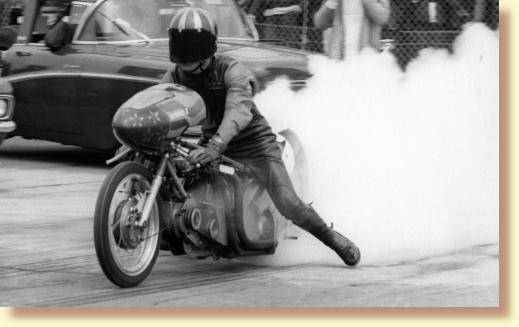
Despite these problems John began doggedly improving the machine to the point that at the 1972 Whitsun meeting at Santa Pod he won a series of match races against Mick Butler who was riding the 1000cc blown Vincent Pegasus with a number of solid 9 second runs. The two riders were performing rolling burn outs much to the delight of the crowd. In July John laid down a 9.84 second 154 mph pass and in August improved still further with 9.6 seconds at a whopping 160 mph. This was not only the first time that a motorcycle had achieved a 160 mph terminal speed in Europe, it was a truly astonishing feat when the top fuel dragsters of the time were only capable of just over 200 mph. John had determined that this year would be the last year that he would actively pursue world records and he therefore decided to attend both the NSA and ISO meetings. The first meeting was organised by the NSA at RAF Fairford and was held over the weekend of 23 and 24 September. John took the standing start kilometre record with an average time of 18.605 seconds averaged over both runs. What was significant was that one of the runs was timed at 17.75 seconds and this was the first time a 17 second clocking had ever been recorded
over this distance. Ray Feltell took the standing start quarter record with a time of 9.905 seconds riding an over-bored 750cc Triumph. The next weekend John arrived at Elvington for the ISO-organised records meet. As was customary he picked up a pan full of records.
John�s performance over the kilometre earned him one of the ACU�s coveted Gold Stars which they gave to anyone who could complete this distance with an average speed of 120 mph or more. The conditions at Elvington were far from ideal with a vicious cross-wind affecting the riders. Eye witnesses reported seeing John blown fully 10 yards off course on one of the longer runs with the bike at full chat. John had no option but to throttle back momentarily and re-aim for the timing lights. The standing start mile record was particularly satisfying for John because despite it being worst-affected by the conditions, he smashed George Brown�s old record of 28.032 seconds which had stood since 1966. It was worth recording here just what it is like riding a machine like Olympus II on these longer record attempts. The acceleration obviously levels out the further you go but it did not stop John achieving speeds estimated to be in the region of 200 mph for as long as 10 seconds. You would have thought that being stretched out directly above two highly-tuned, blown, nitro-burning engines would make you very well aware of their rather menacing presence. Not so. The wind noise and the buffeting experienced on an un-faired bike at very high speeds is so extreme that it causes the rider�s senses to become totally dislocated from what is going on with the machine. There is absolutely none of the usual feedback and the rider effectively becomes a passenger. It is doubtless for this reason that John looks back on these runs as the most exhilarating of his entire career. I suppose that is one way of putting it. John rounded off the season by winning the Top Bike final at the G-Max Grand Trophy Meeting at the Pod held on 21 and 22 October with a 9.91/146.41 lap. Mark II
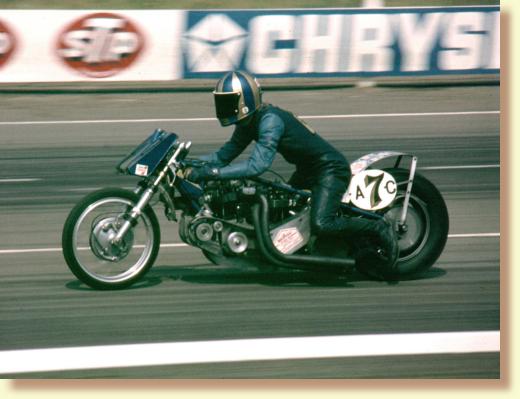
When John took stock of his 1972 season he noted that the twin-engined bike had run barely a few hundredths of a second quicker than the single, but it was consistently capable of 20 to 30 mph higher terminal speeds. The lesson was obvious - the double was producing much more horsepower (hence the high terminal speeds) but it could not be used effectively because the bike would not launch properly. John was on the steepest of learning curves and he knew that the answer was an almost completely new bike with only such components as the forks, gearbox and superchargers being retained from the Mark I machine. When you are aiming to run in the eight second zone at 170 mph John reasoned that there was no room for half measures. Lessons had been learned in respect of the frame and these were incorporated into a new design. John also took advantage of the fact that the rules had been changed to allow motorcycles of up to 2000cc to compete. He therefore abandoned his trusty 500cc units and employed two 650cc Triumph motors equipped with Morgo barrels taking the total capacity of the machine up to 1500cc. This was a courageous decision in many ways because in doing this he knew that his problems with the drive train and traction generally were going to be accentuated considerably. However, as you might expect, John had a few ideas on how to get over this although as always he was inhibited by his limited budget. The problem of the slick not hooking up was addressed full-on by the use of a 7�� M&H slick mounted on a 14� diameter Woolfrace wheel (these were meant to be used on cars but never mind). This was the first time such a large slick had been used by a British rider. The clutch was beefed up by the incorporation of special sintered iron clutch plates made by Ray Baskerville. Sintering is a process whereby powdered metallic material is applied and then fused on to the plates in a furnace. The idea was that these plates should be well capable of enduring extreme heat and the clutch could then be allowed to slip rather than the rear wheel spin, in this way some control might be established over the launch. The final improvement to the clutch was the fitting of additional clutch springs. However, the weak link in the transmission was still the relatively stock Norton gearbox which was used in third and fourth gears only. John simply had nowhere to go with this component. He could not afford a two speed Lenco unit which the top American riders had started using, and there was nothing available domestically at that time. There was some light at the end of the tunnel because Ray Baskerville and Pete Miller were developing a two speed transmission using a Laycock overdrive unit as the basis and they planned to mate this to a slider clutch which they were also designing and constructing. George Bewely had also started to develop a two speed transmission for drag racing but it too was at an early stage. John�s other problem within the driveline was the chain linking the two engines together which continued to cause problems. John�s successes on the strip had attracted some very welcome sponsorship. Dick Lawrence (who ran the �Dick�s Place� shop which used to stand near the start line on the right hand side of the strip at Santa Pod) came on board for the second year in succession, and help also came from Morgo and Castrol.
The workload involved in getting all this together was considerable and as a result the bike did not appear until late May of 1973 and it did not exactly set the strip alight. Its first competitive meeting was the July International held on the 21st and 22nd which was attended by Danny Johnson from the USA. Things were still not going swimmingly by the time of the August Bank Holiday meeting when John had the indignity of being number eight qualifier with a time of 10.28 seconds which was the lowest ever bump spot in the Top Bike class. He again went out in round one this time in a close race with Keith Parnell where he got very near to the barrier but still clocked a 150 mph terminal. John had begun to coax some sort of performance out of the bike by the year end. He clocked 9.84/154 at the mid-September meeting and improved this still further to 9.64/150 at the Fireworks meeting held on 3 and 4 November. The increased width of the rear slick may have contributed better traction, but it came at the price of making the bike much more difficult to steer. Present day drag race fans will be familiar with seeing riders hanging over the side of the machine trying to keep it on the straight and narrow. For John this was a completely new phenomenon which he had never encountered with the old 4� slicks. I had always assumed that this leaning out over the side was using the rider�s weight for correction, I was very surprised when John told me that in fact that they are using the pressure of air on their bodies to pull the bike round. It all sounds very scary to me! Mark III
It was apparent that more improvements were going to be necessary if those elusive eight second times were going to be achieved. The upgrades to the bike carried out over the winter of 1973/74 were extensive but not so visually obvious as before. The frame and engines were retained and John concentrated on putting right a number of small things that were wrong before. His main attention was focused on two areas of the drive line. Firstly he engineered his own slider clutch by modifying the existing Norton unit and adding three fingers actuated by centrifugal weights. This would enable the clutch to lock up at the top end (when the full centrifugal effect was being applied to the fingers) whilst at the same time obviating the need for the very heavy clutch springs. John had found it extremely difficult to control the clutch with the additional springs fitted because of the force which had to be applied to the clutch lever. The other weak link to be attended to was the coupling chain between the engines. This was completely scrapped in favour of engine coupling gears using parts from the famous 1000cc Ariel �Square Four�. These were particularly suitable coupling gears because apart from being robust units, they had very deep teeth which would take up any movement between the engines without the gears coming out of mesh and destroying themselves. The Baskerville/Miller two speed had not reached fruition and therefore John was still obliged to retain the Norton gearbox. Apart from the obvious doubts over its strength, it was impossible to �crash� change from 3rd to 4th gear without throttling back, and this was always going to hurt the elapsed times. A clumsy gear change could, and did on occasion, result in the layshaft being blown completely out of the box! Having said that, the Norton box must have been a very robust design because it was being asked to handle the power of two 750cc blown Triumph engines running on the hard stuff. However, the reality was that the 8.5 second times being set by Tom Christenson in the USA on his injected twin-engined Norton were only achievable because of the two speed and slider clutch that were available to him. In March of 1974 Olympus II travelled to the Geneva Motor Show and had the honour of being the only major exhibit on Castrol�s stand. This was very welcome exposure for John and, indeed, for drag racing generally. On the 23rd of June John achieved a significant milestone when he became the first European to better Alf Hagon�s time of 9.206 seconds which, amazingly, had stood since 1968. John�s run was 9.17 seconds at 146.84 mph, the slightly disappointing terminal speed being caused by a lowering of the gearing to aid the launch off the line. This was followed up two weeks later by an almost identical time of 9.16 seconds at 155.28 mph (the usual gearing had been reinstated). John�s home made clutch was found wanting towards the end of the season when it literally exploded at the top end causing extensive damage fortunately without injury to the rider.
That was as close to the eights as Olympus II was destined to go because it was sold to Chris Richards at the end of the season. John had even more ambitious plans afoot following the announcement in August that Motor Cycle would back the construction of an entirely new machine with the firm intention of running well into the eights. |
|
All material on this site is copyright |
|
|